
Michael Saylor’s X post takes centre stage as the founder shares a solution to Bitcoin stacking.
The Strategy chairman shared an image of an all-orange Rubik’s Cube. The caption read: “Millions of Possibilities, One Solution.”
Strategy Founder Claims STRC is the Key
Saylor’s post looks like a standard Bitcoin cheer. But the “one solution” likely refers to STRC, not BTC itself. Those are the company’s new preferred shares launched in 2025.
In a recent post, the Bitcoin holding company shared that STRC recorded $1.156 billion in daily traded volume.
Since April 13, STRC has converted market liquidity into direct Bitcoin buys. This week alone, the firm raised funds to buy 17,284.73 Bitcoins. Strategy’s reserves may have already topped 800,000 Bitcoin (BTC).
Related Reading: Hackers Steal Over 1 Billion Polkadot (DOT) Coins in a New Cross-Chain Exploit
The company must collect an extra 20% to meet its goal for 1,000,000 Bitcoin assets. At its current buying rate of about 9,000 Bitcoin per week, this should take approximately 24 weeks to accomplish, and is estimated to reach this target sometime in late 2026.
The STRC works by exploiting the spread between capital costs and Bitcoin’s yield. Shares trade at parity to $100. The company’s holdings are now valued at just over $57.7 billion.
Bitcoin Whales on the Move
Bitcoin price remains fairly stable right now. It is gravitating between $75,000 and $74,000, with a 4.5% gain over the past seven days.
But underneath, whales are messing with liquidity. CoinGlass data shows upper liquidity stacked heavily up to $78k. The market looks magnetized toward that level, but friction will be intense.
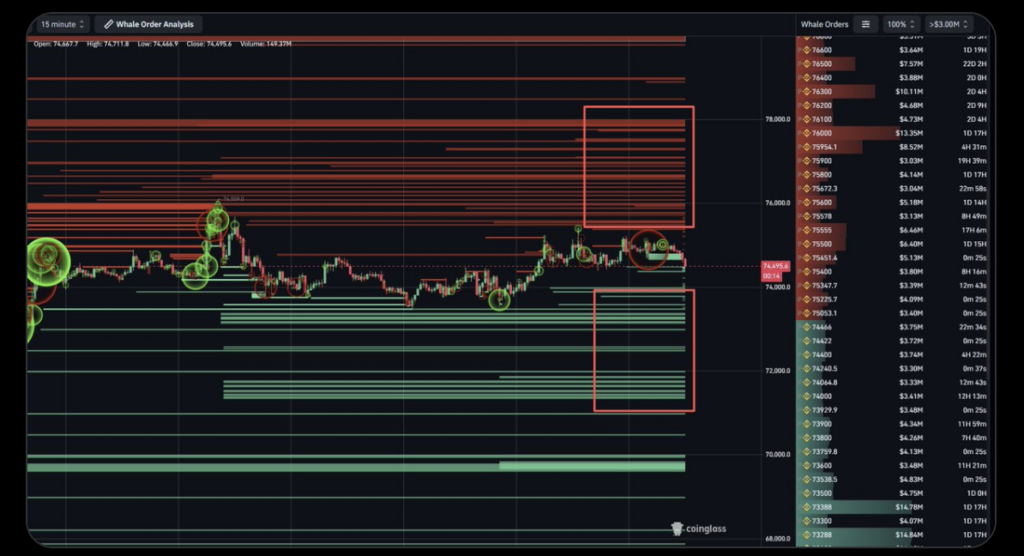
Support zones stay solid at $71k-$73k. Coinglass calls this “standard whale behavior. They built the tower, just to watch it fall.”
Trader @LiberaInvest disagrees about the threat. He believes order book depth is a transient mirage.
Large sell walls at $78k are often psychological spoofing. Whales use them to suppress price or build liquidity for hidden buy orders.
Passive orders can cancel in milliseconds, even before they have a chance to execute. So static heatmaps can be a deceptive metric.